

Traveling by train through Japan is an experience in itself. From the iconic white bullet train zooming through the landscape to local trains cheerfully decorated in the theme of the city. Despite being one of the busiest networks in the world, everything runs tightly, neatly, and surprisingly quietly. It is organized chaos in the best sense of the word. And while we might sigh at a delay back home, that is almost unthinkable in Japan. Before you begin your train adventure, it’s helpful to know how the system works. In this article, you will find useful tips for traveling by train in Japan, with explanations about the rail network, buying a Japan Rail Pass, traveling with the Shinkansen, and the most important train etiquette.


Japan’s Rail Network
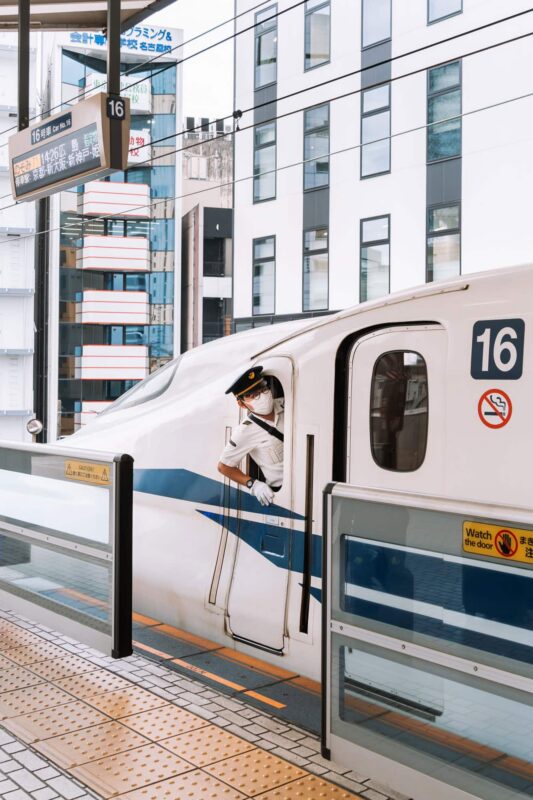
The train network in Japan is one of the most efficient in the world. This is not just due to punctuality, but also because of the way everything is interconnected. The Shinkansen, or the Japanese high-speed train, forms the backbone of the country. These gleaming white trains whiz between major cities like Tokyo, Osaka, and Kyoto at high speeds of up to 320 kilometers (198.8 miles) per hour. They are not only lightning-fast but also extremely comfortable with spacious seats and quiet cabins. For long distances, this is *the* way to travel. Additionally, there are regional and local trains that connect smaller towns and villages. They travel slower and stop more often, but they take you to places the Shinkansen does not reach. These trains are also known for their punctuality and cleanliness.
The Japanese rail network consists of several companies, of which Japan Rail (JR) is the largest. Japan Rail manages most Shinkansen lines and a large part of the regional network. There are also private companies, such as Kintetsu or Hankyu, which are mainly active around the major cities. Despite all these different companies, everything connects perfectly. You can transition from a JR line to a private line and eventually to a bus line without any hassle.


The Japan Rail Pass: To Buy or Not to Buy?
The Japan Rail Pass is a popular train subscription specifically for travelers. With this pass, you can travel unlimitedly on the vast JR network that covers almost all of Japan, and this can be cheaper than constantly buying individual tickets. Whether this is cheaper depends on your travel itinerary, and many travelers wonder whether the Japan Rail Pass is useful for them or not.
The JR Pass can be a great option for those traveling many long routes in a short period and wanting to discover the major cities at high speed—literally and figuratively. A single trip from Tokyo to Kyoto with the Shinkansen costs approximately $110 (100 euros) individually, so if you want to cover several such distances in a short time, the Japan Rail Pass is highly recommended. However, if you travel at a slower pace and visit smaller spots, individual tickets are more economical. If you follow our Japan itinerary, the JR Pass is generally not more cost-effective, and I recommend traveling with an IC card (similar to a transit smart card) combined with individual train tickets. I will tell you more about that later in the article.


Where Do You Buy the Japan Rail Pass?
Once you have decided to purchase the Japan Rail Pass, it is best to do so before your trip. This is not only easier but also more affordable. Although you can purchase the JR Pass on-site in Japan, the price is usually a bit higher there. Therefore, ordering online in advance is the smartest choice. We recommend ordering the Japan Rail Pass through GetYourGuide because the price is more competitive than through the official website, and you can also cancel up to 7 days before departure and receive 80% of your purchase price back. This is handy in case your travel plans change spontaneously. After purchase, you will receive a voucher that you can exchange in Japan for the physical pass. You do this at a JR office at the airport or a major train station, such as in Tokyo, Kyoto, or Osaka.
An advantage is that you can buy the pass up to three months in advance, but you can specify the activation date yourself when picking up the pass. For example, you can stay in Tokyo for a few days first and activate the pass on the day you travel further with the Shinkansen.
Tip: You can reserve seats for the Shinkansen or Limited Express trains free of charge at any JR counter. This is useful during busy periods such as the cherry blossom season.

Planning Your Train Travels
The rail network in Japan is so extensive that you can literally cross the entire country with it, and with all those lines and names, it can sometimes feel quite overwhelming. Fortunately, there are handy tools to help you plan routes and reserve tickets easily.
Google Maps, in particular, will be your best friend during your trip through Japan. The app not only clearly shows you which connection is the fastest but also displays current departure times, platform numbers, and prices. This is ideal for budgeting your travel costs in advance. Once you start your route, Google Maps even keeps track of where you are, when you need to get off, and which exit is best to take. The latter is not a luxury, as Japanese stations can sometimes feel like mazes with dozens of exits and lines.
Before departure, download the maps in Google Maps for the areas you are visiting. This allows you to navigate offline in Japan. Keep in mind that offline maps do not show live departure times or real-time updates. However, that is not a problem in Japan: free Wi-Fi is available at many stations, airports, cafes, 7-Elevens, and even in some Shinkansen trains. If you prefer to always be online, you can easily purchase an eSIM with a data bundle before your trip.
Tip: For long-distance travel, such as with the Shinkansen, the Japan Travel app by Navitime is a great addition. This app also works offline and shows exactly which train you need to take, including transfer times and costs. For short or local trips, however, Google Maps remains the most user-friendly choice.


Different Ways to Buy Tickets Without a JR Pass
There are three different ways to buy tickets for the train and other public transport.
1. Individual Ticket for Every Trip
- Available at machines or counters at every station (most have an English menu).
- Select your destination, pay with cash or credit card, and receive a paper ticket.
- Insert the ticket into the gate when checking in, retrieve it from the other side, and keep it for checking out.
- Did you accidentally travel too far? Use the Fare Adjustment Machine upon exiting to pay the difference.
2. IC Card (Recommended)
The easiest way to travel is with an IC card, such as Suica, Pasmo, or Icoca. It is a rechargeable transit card similar to those used in other major cities. This card works on almost all trains, subways, buses, and even in many shops and vending machines throughout Japan. Ideal!
- You buy and load the card at machines at the airport, stations, or at a convenience store.
- iPhone users can add Suica or Pasmo directly to their Apple Wallet and top it up digitally anywhere.
- Hold the card against the scanner at the gate to check in or out.
3. Tickets for Shinkansen and Limited Express Trains
For the Shinkansen and Limited Express trains, the system works slightly differently.
- In addition to your standard fare, you always need an extra supplement ticket. Combining this with an IC card can sometimes be a bit cumbersome, so it is easier to buy a separate ticket for these train journeys.
- Buy a full ticket, including the supplement, at the machine or the JR counter.
- Sometimes you get two tickets: one for the base fare (the distance you travel) and one for the supplement or seat reservation. Insert them into the gate at the same time, retrieve them from the other side, and keep them for checking out.
- On these trains, you can choose between a reserved seat or a non-reserved seat (slightly cheaper, but you find an empty seat yourself in the correct carriage).
- Want to be sure of a spot on the train, especially during busy days? Book your ticket in advance online via JapanTravel.
Having trouble with your ticket at the station? Almost every station has a staffed counter next to the gates. The staff usually speak some English and are happy to help you.


Bringing Luggage on the Train
There isn’t always a lot of space to store your luggage on the train. On regional trains outside of rush hour, you can usually easily place your suitcase at your feet or on the rack above the seats, but it can be more difficult during busy hours. On the Shinkansen, there is also limited space for large suitcases; there is only space for larger luggage behind the last row of seats.
Usually, you can manage with your suitcases, but if you want to travel light and without the schlep, there is a luggage service called Takuhaibin. This allows you to have your suitcase sent from one address to another. It might sound like a luxury, but in Japan, it is the most normal thing in the world. Simply drop off your luggage at your hotel, a convenience store (such as 7-Eleven, FamilyMart, or Lawson), or a service desk at the station or airport. The staff will then arrange everything for you. Costs are usually between $13 (12 euros) and $19 (17 euros) per suitcase, depending on the distance and size. Within the same region, your luggage is often delivered the next day; for longer distances, it usually takes two days.
Arrange the shipment preferably one day before departure to ensure your suitcase arrives on time. Take a small bag with your essentials for that day.
Tip: Almost everywhere in the country, you will also find coin lockers at the station where you can temporarily store your luggage.

Train Etiquette in Japan
Despite the massive network and the millions of people who use public transport daily, everything in Japan runs remarkably quietly and orderly. There is no pushing, no one cuts in line, and everyone is considerate of one another. This is because there are unwritten rules that almost everyone follows. To help you adapt to Japanese train culture as a traveler, we have listed the most important train etiquette below.
- Silence on the Train – For Japanese people, the train is a place to find some peace. Conversations are conducted quietly, and phones are set to silent by default. Calling on the train is considered impolite.
- Eating and Drinking – On local trains and subways, it is better not to eat; it is considered inappropriate. A drink is fine, but extensive eating is not part of the deal. On the Shinkansen, however, it is actually quite common. Special lunch boxes are sold on the platforms for you to eat during the journey. A handy rule of thumb: if you have a table, you may eat; if there is no table, preferably not. Don’t forget to take your trash with you afterward, as trash cans are scarce.
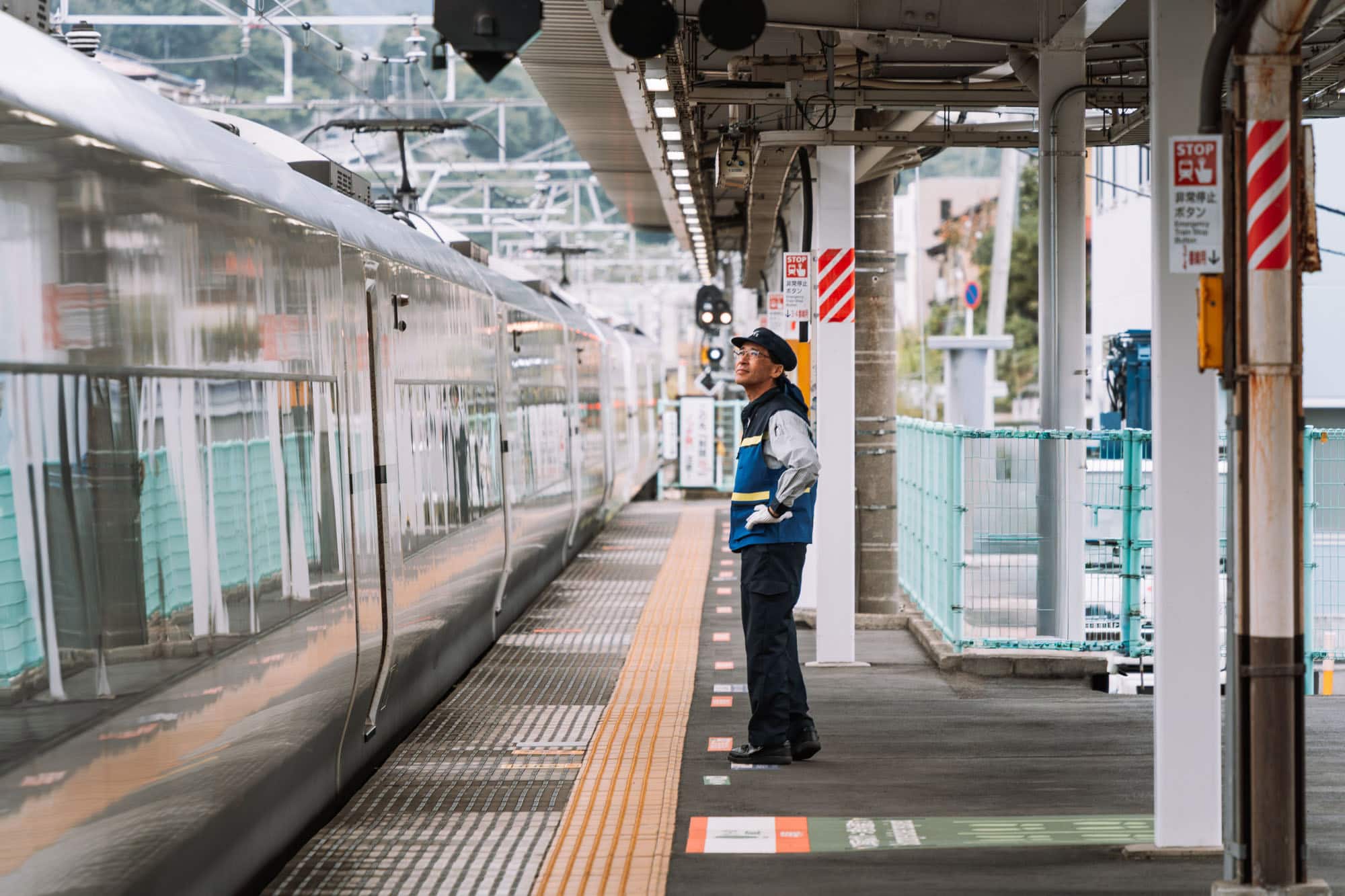
- Waiting for the Train – Colored lines are often marked on the platforms indicating where the train doors will stop. Everyone naturally lines up neatly here. Once the train stops, all passengers exit first before the next group enters calmly. Pushing or cutting in line almost never happens; the system works precisely because everyone is patient. So, join the back of the line and you will notice how smoothly it all goes.
 “`
“`